
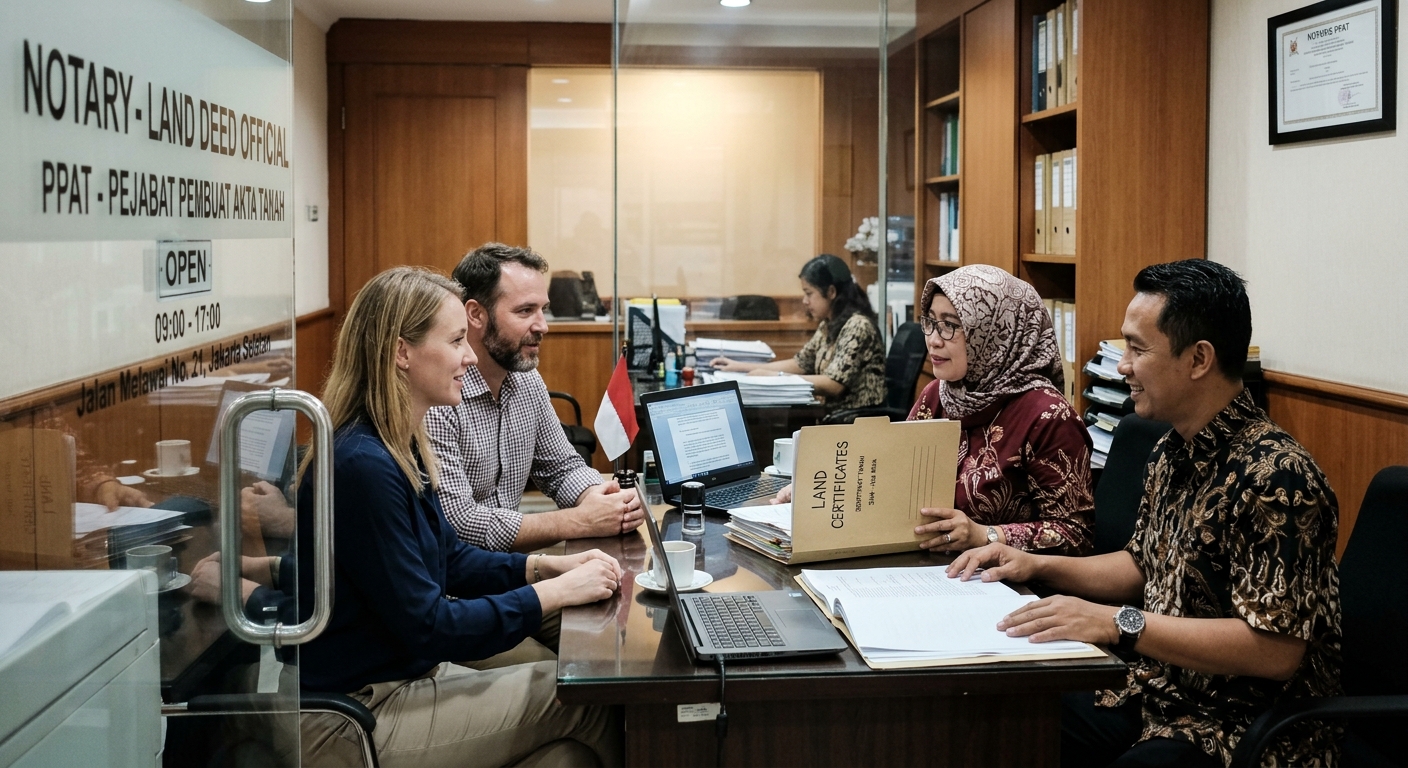
Buying property in Indonesia, whether it’s a sleek Bali villa or a commercial space in Jakarta, is exciting. But let’s address the elephant in the room: Who actually pays the notary fees?
Before signing anything in property transaction, you need a Notary and a Land Deed Official/PPAT to make the deal legally bulletproof.
However, the question of who picks up the tab, the buyer or the seller, confuses almost everyone.
Here is the straight answer: In most property transactions, the buyer foots the bill. But the reality is, the rules aren’t set in stone. Let’s break down exactly how the costs work so you don’t get hit with surprise fees.
Who is Responsible for Indonesian Notary Services Fees?
There isn’t a strict, government-mandated law that forces the buyer to pay 100% of the fees every single time. Instead, the responsibility is determined by the agreement between both parties, usually outlined in the initial Sales and Purchase Agreement/PPJB.
While the standard practice in Indonesia is for the buyer to cover these costs at the signing table, the seller can also agree to absorb them (or split the bill) as part of the overall deal.
The key takeaway? Ensure your agreement explicitly states who is responsible for what. This prevents bad surprises and keeps the transaction smooth.
How Much Do Indonesian Notary Services and Land Deed Officials Cost?
The fees aren’t just made up on the spot; they are heavily regulated. Under Article 36 of Law No. 30 of 2004 on the Notary Profession, fees for Indonesian notary services are calculated based on the economic and social value of the property.
While you might hear people throw around the number “7% to 10%,” that’s actually a bit misleading. Here is the official maximum honorarium scale based on the property’s value:
▪️ Up to IDR 100 Million: Maximum fee is 2.5%.
▪️ IDR 100 Million to IDR 1 Billion: Maximum fee is 1.5%.
▪️ Above IDR 1 Billion: The fee is negotiated directly with the notary, but it cannot exceed 1% of the transaction value.
Important: These percentages only cover the professional fee for Indonesian notary services. They do not include the extra administrative costs you’ll need to pay, such as:
▪️ Drafting the Sale and Purchase Deed (AJB)
▪️ Verifying the land certificate
▪️ Processing the title transfer (Balik Nama)
▪️ Tax validation
▪️ Other land document processing fees
Secure Your Investment with Trusted Indonesian Notary Services
As what’s already written above, generally the buyer covers the notary fees, paid right at the signing table. But if the seller agrees to split the costs or cover them entirely, that’s perfectly legal too. The only thing that matters is that both parties agree and document it clearly.
Doing property transaction in Indonesia as a foreigner can feel like walking through a legal maze. The last thing you want is a technicality ruining your dream villa purchase. You might want to pick trusted local partner.
If you are planning to buy or sell property and need trusted expertise, reach out to legal team at Seven Stones Indonesia. Our team is stacked with seasoned professionals who know the ins and outs of the real estate market.
Seven Stones Indonesia successfully guided hundreds of property investors through major hubs like Jakarta, Bali, and Lombok. Or click this article to learn more about the role of notary services in Indonesia.
