
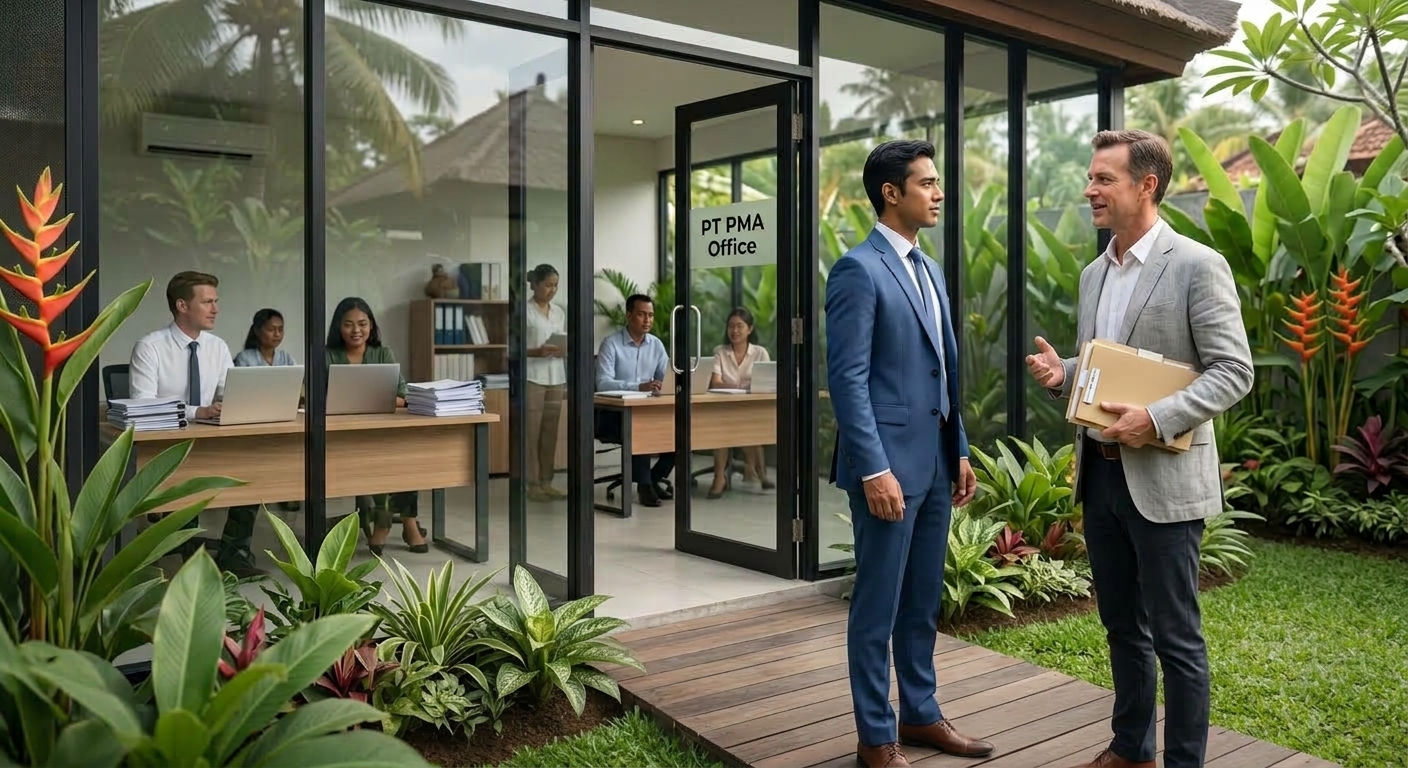
Common Legal Mistakes Foreigners Make When Starting a Business in Indonesia

Starting Business in Indonesia


Starting a business in Indonesia is exciting until someone asks for documents you never heard of before.

Indonesia offers one of Southeast Asia’s most attractive markets, but plenty of foreign investors discover that finding customers is often easier than understanding business regulations.

The good news? Most legal problems are surprisingly predictable. They tend to appear when investors rush through company setup, copy someone else’s structure, or rely on shortcuts that sound clever over coffee but look terrible in court.

Let’s start with one of the biggest mistakes of all.  


1. The Nominee Trap When Starting a Business in Indonesia

One of the most common mistakes when starting a business in Indonesia is relying on a nominee arrangement, often referred to locally as “pinjam nama”.

The concept sounds simple. A foreign investor places company shares or assets under the name of an Indonesian citizen to work around foreign ownership restrictions or capital requirements.

For years, this practice circulated through informal business networks. Some people still assume it is a shortcut to market entry. It isn’t.

Article 33 of Indonesia’s Investment Law No. 25/2007 prohibits nominee arrangements. Courts have repeatedly rejected nominee agreements and treated them as legally unenforceable.

The risk becomes obvious when a dispute arises. The person whose name appears on the official documents is the person recognized by law. A side agreement rarely changes that reality.

Choosing a fully compliant company structure may take more effort at the beginning, but it provides legal certainty and long-term security. 


Read More: From Expat to Entrepreneur: How to Start Legal Business in Indonesia


2.  Choosing the Wrong KBLI before Starting a Business in Indonesia

Another frequent setback when starting a business in Indonesia stems from misclassifying commercial activities under the local classification system, known as KBLI (Klasifikasi Baku Lapangan Usaha Indonesia).

Indonesia uses those 5-digit business codes to designate exact operational boundaries for every enterprise. Selecting an improper code creates immediate friction during registration:

▪️ Ownership Mismatches: Certain KBLI codes allow 100% foreign equity, whereas closely related codes restrict foreign ownership or require local joint-venture partners.

▪️ Licensing Delays: Every KBLI code carries a distinct risk level under the OSS-RBA system, meaning an incorrect code can trigger unnecessary technical inspections or extra permit obligations.

Therefore, verifying KBLI activity definitions with experienced legal advisors before drafting constitutional deeds prevents costly legal re-filings later. 


3  Neglecting Operational Licenses When Starting a Business in Indonesia

Many international founders assume that securing a Business Identification Number (NIB) marks the end of corporate setup when starting a business in Indonesia.

In reality, an NIB only serves as a company’s foundational registration card. Depending on an enterprise’s assigned risk tier under the OSS-RBA framework, additional operational permissions are mandatory before commencing sales:

— Low-Risk Tiers: The NIB serves as a complete license to operate right away.

— Medium-High and High-Risk Tiers: Companies must secure Standard Certificates (Sertifikat Standar) or sector-specific licenses (PB-UMKU) through government verification checks before opening their doors.

Operating without required operational permits can trigger administrative fines, temporary closures, or tax office freezes.


Read More:
Indonesia’s Golden Visa Attracts Rp52.1 Trillion in Investment 


4.  Misunderstanding Capital Rules to Start a Business in Indonesia

A fourth common hurdle when starting a business in Indonesia relates to mixing up corporate capital terminology under current Indonesia Investment Coordinating Board/BKPM Regulation No. 5/2025 guidelines.

The investment framework clearly separates two core concepts:

—  Minimum Paid-Up Capital / Modal Disetor: The mandatory upfront cash deposit of IDR 2.5 billion into an Indonesian corporate bank account to issue shares and start operations (according to Regulation of /BKPM no 5/2025) 

—  Total Investment Value / Nilai Investasi Total: The multi-year project commitment threshold of IDR 10 billion+ per KBLI code (excluding land and buildings), realized over time through operational expenses and expansion.

Assuming that IDR 10 billion in liquid cash must sit untouched in a bank account on day one often deters foreign investors unnecessarily.   


Starting Business with Seven Stones Indonesia

While legal regulations in Southeast Asia’s largest economy may seem intimidating, avoiding these four common pitfalls ensures a smooth market entry.

Avoid risky nominee arrangements by structuring a 100% compliant foreign enterprise. Talk to Seven Stones Indonesia’s legal specialists for safe and transparent PT PMA setup via WhatsApp today.

Let’s schedule a complimentary 30-minute consultation and structure a compliant, profitable corporate presence in Indonesia.



Latest Article
Common Legal Mistakes Foreigners Make When Starting a Business in Indonesia
  Starting a business in Indonesia is exciting until someone asks for documents you never heard...
From Expat to Entrepreneur: How to Start Legal Business in Indonesia
  Learning how to start legal business in indonesia opens more commercial opportunities for foreign...
Bumper Weekend for Concerts, Jakarta Rakes in IDR 250 Billion in Just Two Days
  Jakarta Governor Pramono Anung highlighted that large-scale music events have provided a significant...
QRIS Transactions by Foreign Tourists Reach Rp6.2 Trillion in Indonesia
  Digital payment convenience is becoming increasingly evident for international visitors traveling...
Art Jakarta 2026 Returns Bigger with Local and Global Galleries
  Indonesia’s leading art fair, Art Jakarta, will return on October 2-4, 2026, at JIExpo Kemayoran...

Andrzej Barski

Director of Seven Stones Indonesia

Andrzej is Co-owner/ Founder and Director of Seven Stones Indonesia. He was born in the UK to Polish parents and has been living in Indonesia for more than 33-years. He is a skilled writer, trainer and marketer with a deep understanding of Indonesia and its many cultures after spending many years travelling across the archipelago from North Sumatra to Irian Jaya.

His experience covers Marketing, Branding, Advertising, Publishing, Real Estate and Training for 5-Star Hotels and Resorts in Bali and Jakarta, which has given him a passion for the customer experience. He’s a published author and a regular contributor to local and regional publications. His interests include conservation, eco-conscious initiatives, spirituality and motorcycles. Andrzej speaks English and Indonesian.

Terje H. Nilsen

Director of Seven Stones Indonesia

Terje is from Norway and has been living in Indonesia for over 20-years. He first came to Indonesia as a child and after earning his degree in Business Administration from the University of Agder in Norway, he moved to Indonesia in 1993, where he has worked in leading positions in education and the fitness/ wellness industries all over Indonesia including Jakarta, Banjarmasin, Medan and Bali.

He was Co-owner and CEO of the Paradise Property Group for 10-years and led the company to great success. He is now Co-owner/ Founder and Director of Seven Stones Indonesia offering market entry services for foreign investors, legal advice, sourcing of investments and in particular real estate investments. He has a soft spot for eco-friendly and socially sustainable projects and investments, while his personal business strengths are in property law, tourism trends, macroeconomics, Indonesian government and regulations. His personal interests are in sport, adventure, history and spiritual experiences.

Terje’s leadership, drive and knowledge are recognised across many industries and his unrivalled network of high level contacts in government and business spans the globe. He believes you do good and do well but always in that order. Terje speaks English, Indonesian and Norwegian.

Contact Our Consultants

[wpforms id=”43785″]

Ridwan Jasin Zachrie

CFO of Seven Stones Indonesia, Jakarta

Ridwan is one of Indonesia’s top executives with a long and illustrious career in the financial world. He holds several professional certifications including being a Certified Business Valuer (CBV) issued by the Australian Academy of Finance and Management; Broker-Dealer Representative (WPPE); and The Directorship Certification for Directors and Commissioners, issued by the Indonesian Institute of Commissioners and Directors.

His experience includes being the Managing Director at one of the top investment banking groups in the region, the Recapital Group, the CFO at State-owned enterprises in fishery industry and the CEO at Tanri Abeng & Son Holding. He’s also been an Independent Commissioner in several Financial Service companies and on the Audit and Risk Committee at Bank BTPN Tbk, Berau Coal Energy Tbk, Aetra Air Jakarta as well as working for Citibank, Bank Mandiri and HSBC. His last position was as CFO at PT Citra Putra Mandiri – OSO Group.

Ridwan has won a number of prestigious awards including the Best CFO Awards 2019 (Institute of Certified Management Accountant Australia-Indonesia); Asia Pacific Young Business Leader awarded by Asia 21 Network New York USA (Tokyo 2008); UK Alumni Business Awards 2008 awarded by the British Council; and The Most Inspiring Human Resources Practitioners’ version of Human Capital Magazine 2010.

He’s a member of the Board of Trustees of the Alumni Association of the Faculty of Law, Trisakti University, Co-Founder of the Paramadina Public Policy Institute and actively writes books, publications and articles in the mass media. He co-authored “Korupsi Mengorupsi Indonesia” in 2009, which helps those with an interest in understanding governance in Indonesia and the critical issue of corruption. Ridwan speaks Indonesian and English.

Per Fredrik Ecker

Managing Director of Seven Stones Indonesia, Jakarta

Per is the Managing Director of the Seven Stones Indonesia (SSI) Jakarta office and has more than 25-years’ experience in Indonesia, China, and Western Europe. He previously worked in senior management positions with Q-Free ASA, Siemens AG, and other companies in the telecom sector. Over the last six years, he has been the Chairman of the Indonesia-Norway Business Council (INBC) and recently become elected to be on the board of EuroCham Indonesia.

His most recent experience is within Intelligent Transport Solutions (ITS), Telecom, and other sectors within the Indonesian market. He is today through his position in SSI and by representing Norway Connect, promoting Nordic and European companies that would like to explore business opportunities in the Indonesian market. He’s also playing an active role to help create the Nordic House concept in Jakarta that will provide an excellent platform for Nordic companies entering Indonesia, where they’ll find a community that can offer support with trusted information and affordable services to enter this market.