
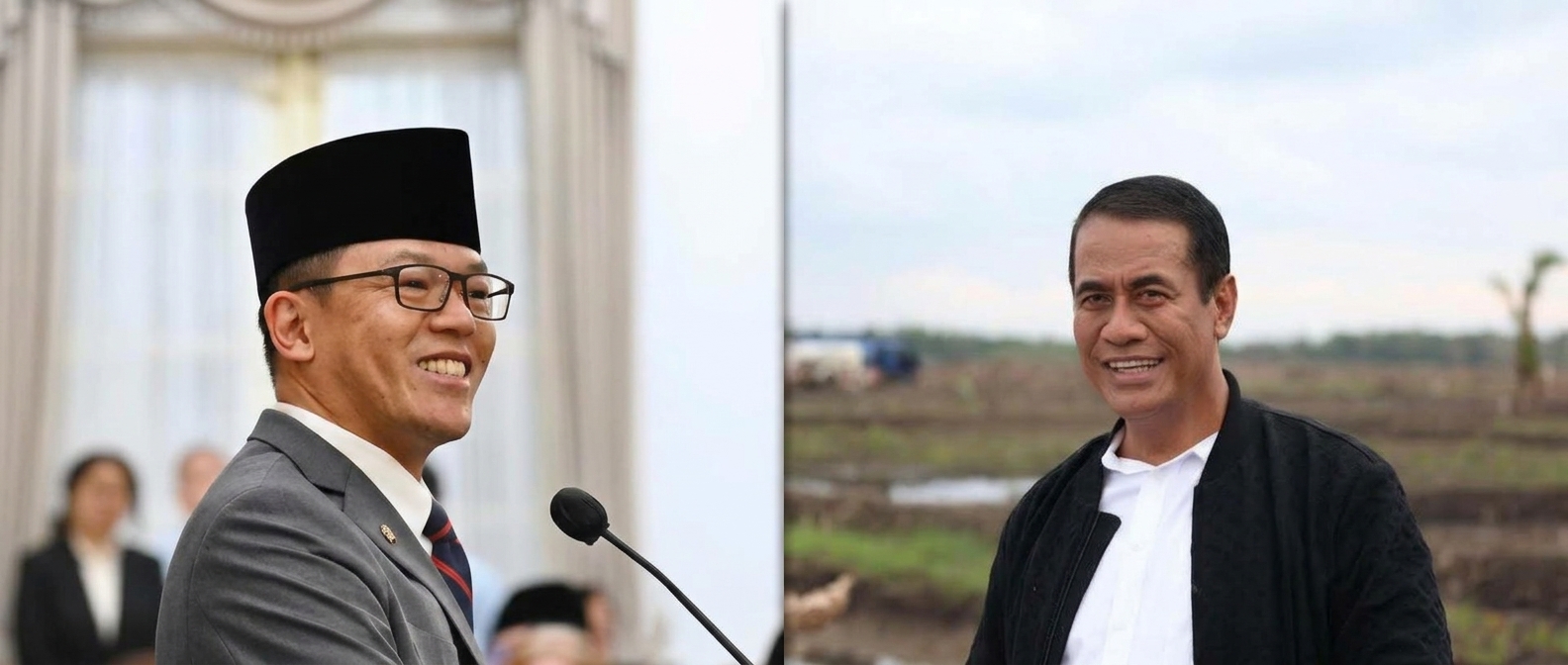
Indonesia Vice President Election: The Battle Between Sugiono and Amran Sulaiman


With Gibran out, the race for Indonesia’s second-highest office is heating up. Here is the political map ahead of the December 11 vote.


The resignation of Gibran Rakabuming Raka on November 12, 2026, has set the stage for one of the most closely watched political maneuvers in recent Indonesian history: the Indonesia Vice President Election.

On December 11, 2026, the People’s Consultative Assembly (MPR) comprising 580 DPR members and 152 DPD members will gather to elect Gibran’s replacement for the remainder of the 2024–2029 term.

President Prabowo Subianto has put forward two distinct candidates: Sugiono, the Coordinating Minister for Human Development and Culture (and Gerindra’s Secretary-General), and Amran Sulaiman, the Minister of Agriculture.

Here is how the political landscape is shaping up.


Sugiono’s Early Momentum

Sugiono enters the race with the clear backing of the President’s inner circle. He is viewed by many as Prabowo’s “ideological child,” a figure capable of solving the loyalty issues currently plaguing the palace.

As of late November, three major parties have officially thrown their weight behind him: Gerindra, NasDem, and PAN.

“The Gerindra faction officially and all-out supports Brother Sugiono as the vice presidential candidate. We are calling on other MPR members… to also support Sugiono so that hopefully, there is no need for a vote,“ said Habiburokhman, Head of the Gerindra MPR Faction.

However, Sugiono’s early support base is not yet large enough to guarantee a win. With Gerindra (86 seats), NasDem (69 seats), and PAN (48 seats), he currently controls roughly 203 DPR seats. This is only about 35% of the DPR, or 27.7% of the total 732 MPR members.


The Amran Threat and the “Electoral Danger”

While Sugiono has the early institutional support, Amran Sulaiman poses a unique threat if the election goes to an open vote.

Amran is a two-term minister known for his extensive network, proven logistical strength, and high public satisfaction as the Minister of Agriculture.

Political analyst Burhanuddin Muhtadi points out that this popularity makes Amran a risky choice for coalition parties looking ahead to the 2029 election.

“Electorally, for parties other than Gerindra, Amran is more threatening. So at a certain point, they actually have an interest in choosing Sugiono,“ Burhanuddin explained.

This dynamic creates a paradox: Amran may be the stronger candidate in an open vote, but Sugiono is the safer bet for party leaders who want to protect their own electoral dominance.


The Wildcards: Who Holds the Real Power?

With 377 DPR seats and 152 DPD members still undecided, the game is far from over.

➔  Golkar (102 seats): Officially playing it safe, but Vice Chairman Ahmad Doli Kurnia signaled they will likely follow Gerindra’s lead and support Sugiono.

➔  PDI-P (110 seats): The largest party in parliament is waiting for a final directive from Megawati Soekarnoputri.

➔  PKB, PKS, and Democrats: All are holding back, waiting for internal party decisions (like PKB’s istikharah or PKS’s Shura Council) or the direction of their respective chairmen.

The DPD is another major wildcard. With over one-fifth of the total MPR votes, their 152 members could decide the outcome if a vote is held. DPD Speaker Sultan Baktiar Najamudin stated they will consult directly with President Prabowo before making a final decision.


The Big Question: Consensus or Vote?

As the December 11 date approaches, the biggest question is how the vote will happen.

According to the constitution, the MPR must first attempt to reach musyawarah mufakat (consensus). Only if consensus fails will it move to a direct vote (one man one vote).

Gerindra’s Habiburokhman is pushing hard for the consensus route. But if it goes to a vote, the dynamic shifts entirely. As political analyst Yunarto Wijaya noted, in an open contest, Amran’s logistical experience and broader networks could give him the edge over Sugiono.


High-Stakes Test for Prabowo’s Coalition 

The Indonesia Vice President Election is a test of Prabowo’s political grip and the coalition’s true loyalties. Sugiono has the structural advantage and the President’s backing. Amran has the popular appeal and the raw political weight.

With almost half of the MPR still undecided, the next two weeks will be a high-stakes game of political chess. Whatever the outcome, the winner will shape Indonesia’s political landscape leading up to 2029.


Sources: Kompas, TintaHijau

Latest Article
Indonesia Vice President Election: The Battle Between Sugiono and Amran Sulaiman
  With Gibran out, the race for Indonesia’s second-highest office is heating up. Here is the political...
Prabowo Requests Delay, New Vice President to Be Elected December 9
  The resignation of Gibran Rakabuming Raka as Vice President of Indonesia on November 12, 2026,...
Indonesian Notary Services: How to Make Your Overseas Documents Legally Valid
  Indonesian notary services are essential for any expat or foreign business that needs overseas...
Bogor to Labuan Bajo Expected to Draw Holiday Crowds This Christmas and New Year
  Several destinations across Indonesia are expected to be among the most popular choices for travelers...
Indonesian Notary Services: Who Actually Pays the Fees in Property Deals?
  Buying property in Indonesia, whether it’s a sleek Bali villa or a commercial space in Jakarta,...

Andrzej Barski

Director of Seven Stones Indonesia

Andrzej is Co-owner/ Founder and Director of Seven Stones Indonesia. He was born in the UK to Polish parents and has been living in Indonesia for more than 33-years. He is a skilled writer, trainer and marketer with a deep understanding of Indonesia and its many cultures after spending many years travelling across the archipelago from North Sumatra to Irian Jaya.

His experience covers Marketing, Branding, Advertising, Publishing, Real Estate and Training for 5-Star Hotels and Resorts in Bali and Jakarta, which has given him a passion for the customer experience. He’s a published author and a regular contributor to local and regional publications. His interests include conservation, eco-conscious initiatives, spirituality and motorcycles. Andrzej speaks English and Indonesian.

Terje H. Nilsen

Director of Seven Stones Indonesia

Terje is from Norway and has been living in Indonesia for over 20-years. He first came to Indonesia as a child and after earning his degree in Business Administration from the University of Agder in Norway, he moved to Indonesia in 1993, where he has worked in leading positions in education and the fitness/ wellness industries all over Indonesia including Jakarta, Banjarmasin, Medan and Bali.

He was Co-owner and CEO of the Paradise Property Group for 10-years and led the company to great success. He is now Co-owner/ Founder and Director of Seven Stones Indonesia offering market entry services for foreign investors, legal advice, sourcing of investments and in particular real estate investments. He has a soft spot for eco-friendly and socially sustainable projects and investments, while his personal business strengths are in property law, tourism trends, macroeconomics, Indonesian government and regulations. His personal interests are in sport, adventure, history and spiritual experiences.

Terje’s leadership, drive and knowledge are recognised across many industries and his unrivalled network of high level contacts in government and business spans the globe. He believes you do good and do well but always in that order. Terje speaks English, Indonesian and Norwegian.

Contact Our Consultants

[wpforms id=”43785″]

Ridwan Jasin Zachrie

CFO of Seven Stones Indonesia, Jakarta

Ridwan is one of Indonesia’s top executives with a long and illustrious career in the financial world. He holds several professional certifications including being a Certified Business Valuer (CBV) issued by the Australian Academy of Finance and Management; Broker-Dealer Representative (WPPE); and The Directorship Certification for Directors and Commissioners, issued by the Indonesian Institute of Commissioners and Directors.

His experience includes being the Managing Director at one of the top investment banking groups in the region, the Recapital Group, the CFO at State-owned enterprises in fishery industry and the CEO at Tanri Abeng & Son Holding. He’s also been an Independent Commissioner in several Financial Service companies and on the Audit and Risk Committee at Bank BTPN Tbk, Berau Coal Energy Tbk, Aetra Air Jakarta as well as working for Citibank, Bank Mandiri and HSBC. His last position was as CFO at PT Citra Putra Mandiri – OSO Group.

Ridwan has won a number of prestigious awards including the Best CFO Awards 2019 (Institute of Certified Management Accountant Australia-Indonesia); Asia Pacific Young Business Leader awarded by Asia 21 Network New York USA (Tokyo 2008); UK Alumni Business Awards 2008 awarded by the British Council; and The Most Inspiring Human Resources Practitioners’ version of Human Capital Magazine 2010.

He’s a member of the Board of Trustees of the Alumni Association of the Faculty of Law, Trisakti University, Co-Founder of the Paramadina Public Policy Institute and actively writes books, publications and articles in the mass media. He co-authored “Korupsi Mengorupsi Indonesia” in 2009, which helps those with an interest in understanding governance in Indonesia and the critical issue of corruption. Ridwan speaks Indonesian and English.

Per Fredrik Ecker

Managing Director of Seven Stones Indonesia, Jakarta

Per is the Managing Director of the Seven Stones Indonesia (SSI) Jakarta office and has more than 25-years’ experience in Indonesia, China, and Western Europe. He previously worked in senior management positions with Q-Free ASA, Siemens AG, and other companies in the telecom sector. Over the last six years, he has been the Chairman of the Indonesia-Norway Business Council (INBC) and recently become elected to be on the board of EuroCham Indonesia.

His most recent experience is within Intelligent Transport Solutions (ITS), Telecom, and other sectors within the Indonesian market. He is today through his position in SSI and by representing Norway Connect, promoting Nordic and European companies that would like to explore business opportunities in the Indonesian market. He’s also playing an active role to help create the Nordic House concept in Jakarta that will provide an excellent platform for Nordic companies entering Indonesia, where they’ll find a community that can offer support with trusted information and affordable services to enter this market.