
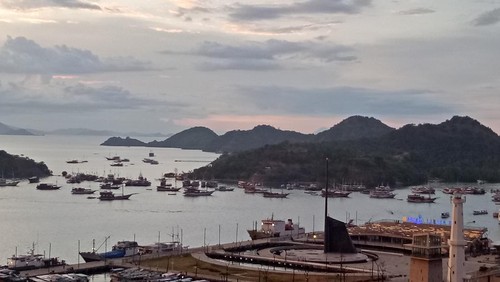
Tourist boat operations in Labuan Bajo, East Nusa Tenggara, have been temporarily suspended as authorities respond to worsening maritime weather conditions. The restriction, imposed by the Labuan Bajo Class III Port Authority and Harbormaster Office (KSOP), applies to all tourist boats operating in and around Komodo National Park and will remain in effect until 20 January 2026, or until weather conditions are deemed safe.
The suspension follows the closure of Sailing Approval Letters (SPB) starting 14 January, based on maritime weather forecasts issued by the Meteorology, Climatology, and Geophysics Agency (BMKG). Forecast data show sea conditions around Labuan Bajo marked by significant wave heights of up to 1.2 meters, strong westerly and northwesterly winds, and fluctuating visibility that poses risks to navigation, particularly for tourism vessels carrying passengers.
Although waters in some parts of Komodo National Park have shown relatively calmer conditions, authorities opted for a comprehensive restriction across all tourism routes to minimize risk and maintain uniform safety standards.
The current suspension also reflects heightened safety awareness following a series of maritime incidents in Komodo waters in recent years. Several cases involved tourist boats running aground on coral reefs, capsizing amid sudden weather changes, or experiencing leaks while navigating between islands. While most incidents were resolved without loss of life, they highlighted recurring challenges related to rapid weather shifts, dense boat traffic on popular routes, and the need for stricter operational discipline.
Strengthening Safety Protocols and Coordination
Labuan Bajo, as the main gateway to Komodo National Park, continues to balance its status as a world-class tourism destination with growing demands for passenger safety and environmental protection. Peak travel periods often see dozens of tourist boats operating simultaneously, increasing the importance of weather-based risk assessments and coordinated traffic management.
In response, KSOP has reinforced safety protocols for all maritime tourism stakeholders. Ship captains are instructed to ensure vessels are seaworthy at all times, adjust routes when conditions deteriorate, and immediately seek shelter in protected areas if weather worsens. Tourist boats already at sea are advised to anchor or secure themselves in safe zones and share real-time information on hazardous conditions with nearby vessels.
Coordination with the National Search and Rescue Agency (Basarnas) remains a key component of emergency preparedness. Authorities have emphasized early reporting of potential dangers and prompt communication to prevent incidents from escalating. The suspension of tourist boat operations will only be lifted after BMKG confirms that sea and weather conditions are safe for passenger travel.
Beyond the immediate restriction, the situation has renewed calls to strengthen safety standards in Labuan Bajo’s maritime tourism sector. These include stricter enforcement of standard operating procedures, improved crew training, clearer passenger safety briefings, and better use of weather and navigation data. Authorities are also encouraging closer coordination between BMKG, KSOP, Komodo National Park managers, and tourism operators to ensure that safety decisions are timely and consistently applied.
While the temporary halt may disrupt travel plans, officials stress that the measure is essential to protect passengers, crews, and the fragile marine environment that underpins Labuan Bajo’s long-term tourism appeal.
Source: CNN Indonesia, Detik, Pantau24Jam
Special Photo Credit: Ambrosius Ardin/detikBali
