

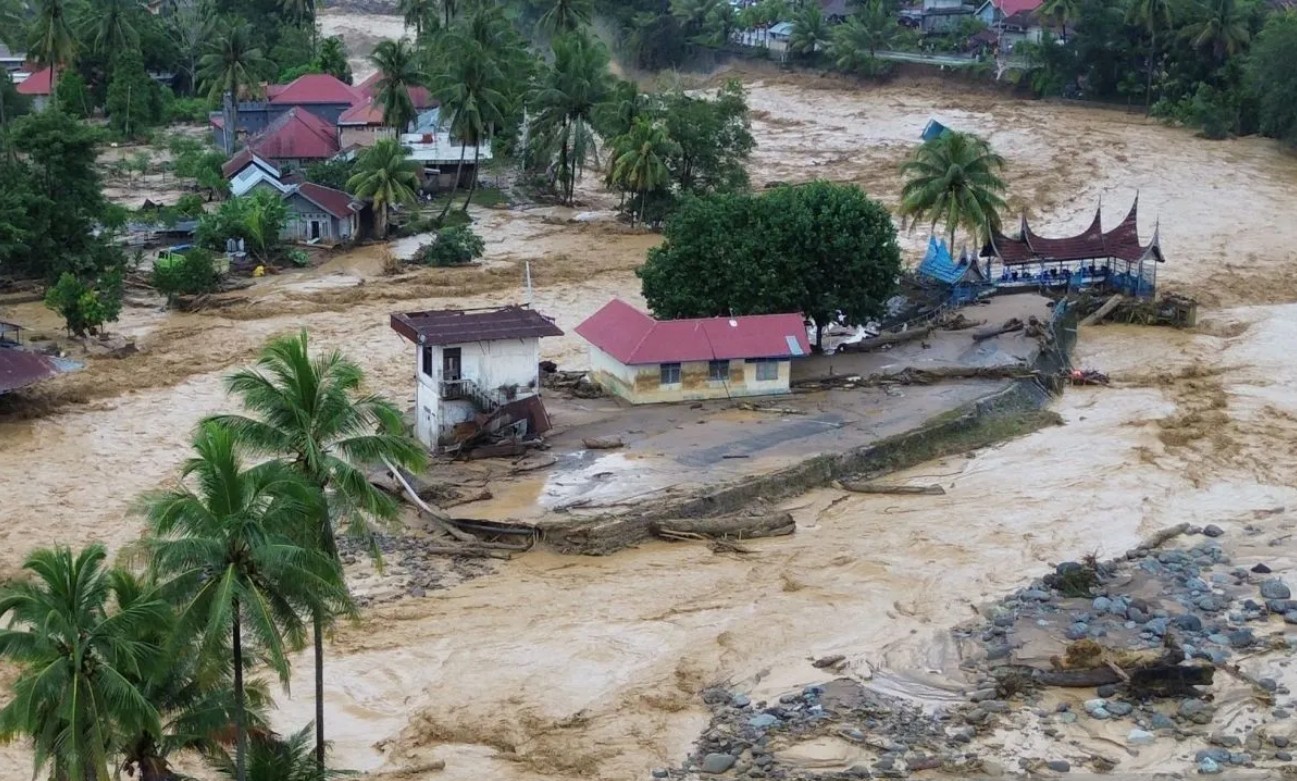
Flash floods and landslides have struck around 50 regencies/cities in Aceh, North Sumatra, and West Sumatra since late November.
As of Wednesday morning (December 3), the National Disaster Management Agency recorded 753 fatalities from the disaster.
The breakdown shows 218 deaths in Aceh with 227 people missing. In North Sumatra, 301 people died and 163 are missing.
President Prabowo Subianto stated that the government will send aid in the maximum amount and as soon as possible.
“We guarantee that aid will be sent as much and as quickly as needed,” said Prabowo. “The budget is already available, and we are making savings to ensure aid can keep flowing,” he added.
Indonesia Finance Minister Purbaya Yudhi Sadewa emphasized that the government has strong funding mechanisms to deal with various disasters.
He explained that the government has prepared an emergency financing scheme that can be activated at any time, covering emergency response needs as well as rehabilitation and social protection for affected residents.
“The ready-to-use funds at the National Disaster Management Agency are still around Rp500 million. If additional funds are needed, we are ready to add them and the budget is already available,” said Purbaya in Jakarta, Monday, December 1, 2025.
National Economic Losses
Beyond the human toll, a study by Celios shows that ecological disasters in Sumatra are projected to have caused national economic losses amounting to Rp 68.67 trillion (around USD 4.12 billion).
This figure includes damage to residential homes, loss of household income, destruction of road and bridge infrastructure, and loss of agricultural production due to flooding and landslides.
— Aceh Province is projected to suffer losses of Rp 2.2 trillion (around USD 132 million)
— North Sumatra is projected to lose Rp 2.07 trillion (around USD 124 million)
— West Sumatra Rp 2.01 trillion (around USD 120 million)
Sustainable Restorative Economy
The calculation of economic losses from flooding in Sumatra, based on the Analysis of Economic Losses from the Sumatra Flood Disaster by CELIOS using data as of November 30, 2025, estimates the losses under five assumptions.
The first loss is from affected housing, estimated at Rp 30 million per house. Next, bridge losses are calculated with each reconstruction costing Rp 1 billion.
Losses are also recorded in household income, calculated according to the average daily income of each province multiplied by 20 working days.
Meanwhile, losses in rice fields are valued at Rp 6,500 per kilogram, assuming each hectare yields 7 tons. Finally, road repair losses are calculated at Rp 100 million per 1,000 meters.
These assumptions highlight that ecological disasters are driven by land-use changes linked to palm oil deforestation and mining. Yet the economic contributions of these industries to provinces such as Aceh are far outweighed by the damage and losses they cause.
In its report, Celios calls for an immediate moratorium on mining permits and palm oil plantation expansion, urging a transition toward a more sustainable, restorative economy. Without structural changes to the economy, ecological disasters will continue to recur, bringing even greater economic losses.
Sources : Celios, CNN Indonesia, Kontan
Feat Images : AntaraNews/Syifa Yulinnas
