
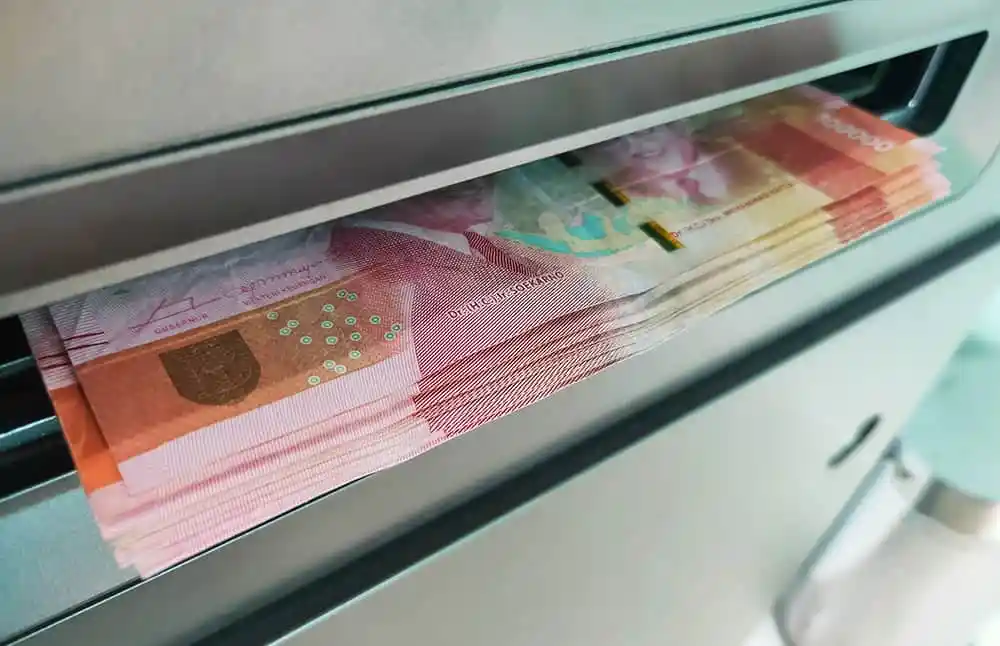
Despite the rapid expansion of digital payment systems across Indonesia, demand for cash remains high during long holiday periods, particularly Christmas and New Year (year-end) and major religious celebrations.
Advisor at the Banking & Finance Development Center, Moch Amin Nurdin, said cash usage remains unavoidable due to longstanding social traditions and mobility patterns. During the previous year-end period, cash circulation exceeded USD 8.3 billion, driven by holiday travel, gift-giving traditions, souvenirs, and cash-based gifting such as angpau.
“Areas around Java usually see a surge, especially in tourism zones, hotels, and MSMEs that sell holiday-specific souvenirs. This helps stimulate regional economic activity,” Amin said on Sunday (14/12/2025), as reported by Kontan.
Amin added that centralized cash management by banks has proven effective in controlling cash circulation, making monitoring more measurable and systematic. He noted that cash will continue to support economic activity, as digital transactions have not yet reached all segments of Indonesian society.
However, he emphasized the importance of ensuring sufficient cash availability, easy access, security, and banking guarantees to keep circulation running smoothly.
Similarly, Vice President of the Indonesian Banking Development Institute (LPPI), Trioksa Siahaan, said Indonesia’s cash demand remains high and could continue to rise, particularly as transactions in traditional markets still heavily rely on cash. He stressed that cash continues to play a vital role, noting that even in developed countries, cash transactions remain widely accepted.
From the banking perspective, Trioksa said current liquidity conditions remain solid. As a result, it is reasonable for banks to maintain large cash reserves to anticipate higher public demand during extended holiday periods, with potential increases compared to previous years.
Holiday Spending Expected to Reach USD 6.9 Billion
Indonesia’s Chamber of Commerce and Industry (Kadin) projects that money circulation during the year-end holidays will reach USD 6.9 billion.
The projection is based on a transportation survey estimating 119.5 million travelers, or 42.01 percent of Indonesia’s population, will be on the move during the holiday period.
“The calculation assumes 119.5 million travelers equal 29.9 million families, with an average of four people per family. If each family brings around USD 230, total money circulation could reach USD 6.9 billion,” said Kadin Deputy Chair for Regional Autonomy, Sarman Simanjorang, on Sunday (14/12/2025), as quoted from Investor.
Sarman noted that the actual figure could exceed projections, as Kadin used a moderate assumption of a 10% increase in family travel spending compared to the previous year.
Survey results also show national mobility is expected to rise by 2.71% year-on-year (yoy), indicating stronger travel momentum despite the upcoming Ramadan season.
Sarman said government incentives have played a major role in boosting public enthusiasm. These include toll road discounts of 10–20%, reduced fares across land, sea, and air transport, and ticket discounts of up to 30% for economy-class rail travel.
“VAT on economy-class flights is covered by the government, while airlines have lowered fares by an average of 13–14%,” Sarman said.
He added that year-end holidays are expected to be a key driver of fourth-quarter economic growth, supporting Indonesia’s full-year growth target of around 5 percent.
Source: Kontan, Investor, RadarSurabaya
Photo Credit: via balisavvy.com
