
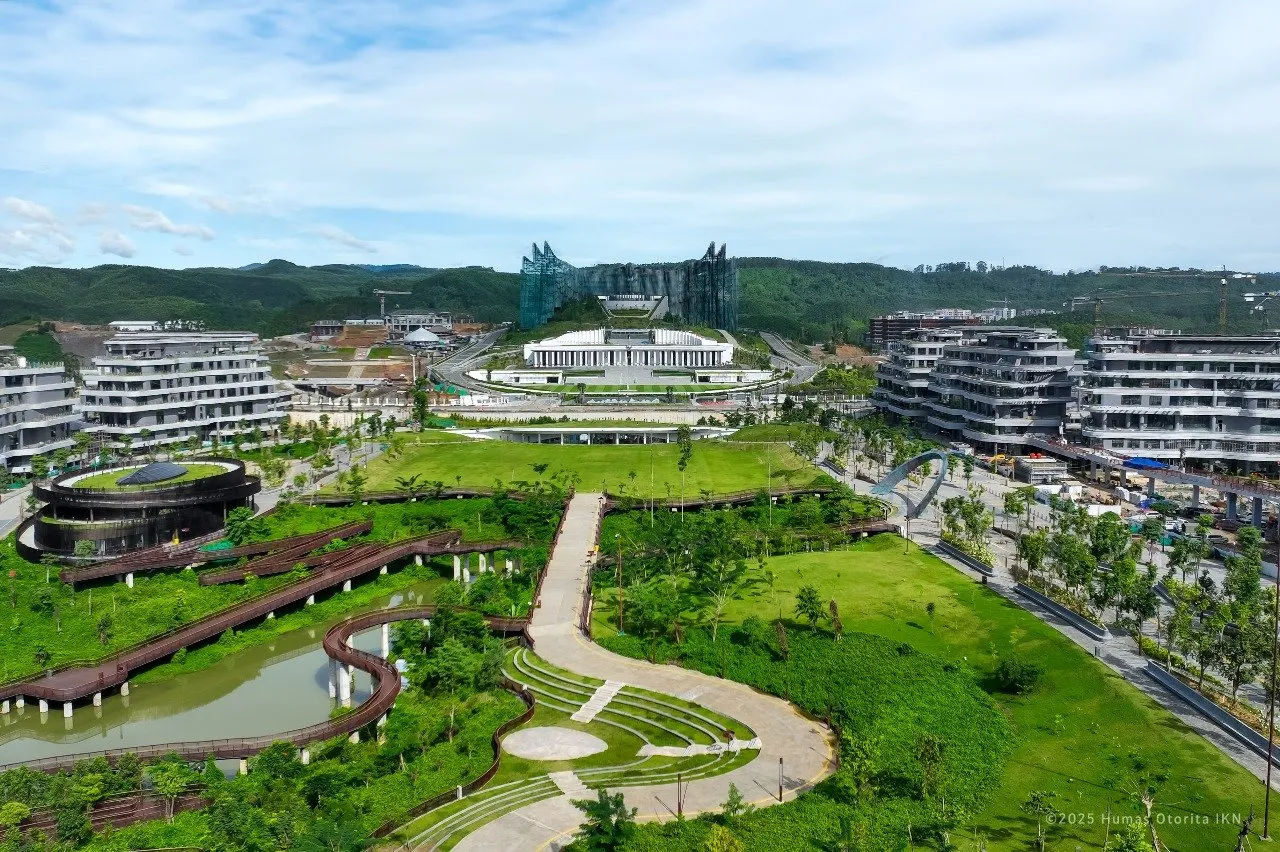
The development of IKN is entering a critical stage as the Nusantara Capital Authority (Otorita Ibu Kota Nusantara/OIKN) advances Phase II construction. This stage focuses on preparing IKN to operate as the country’s political capital by 2028, hosting the core institutions of government including legislative and judicial headquarters.
A major milestone was reached with the signing of six new supervision packages for strategic infrastructure projects. These agreements reinforce quality control and operational standards for on-site development across key zones, marking a decisive shift from planning into intensive, integrated construction.
With the latest signing, 26 out of 28 total Phase II project packages (2025–2028) are now active. The work portfolio consists of 14 physical construction packages and 12 supervision and construction management packages, signaling that IKN has entered a full-scale build-out stage.
The six supervision contracts will deploy specialized teams to oversee project delivery, workforce management, and compliance with technical standards. They cover:
- Road development in the legislative complex (28 personnel; December 2025–October 2027)
- Road development in the judicial complex (23 personnel; December 2025–December 2027)
- Support-area road networks (25 personnel; December 2025–December 2027)
- Reservoir 1B construction (36 personnel; December 2025–November 2027)
- Reservoir 1C development (36 personnel; December 2025–November 2027)
- Retention pond construction (34 personnel; December 2025–November 2027)
These projects are foundational for ensuring water resilience, mobility, and essential urban functions. By creating a reliable hydrological network and stable access routes, OIKN aims to guarantee year-round operability of the new political center.
Strict Compliance and Accountability
OIKN has emphasized that building IKN must reflect a disciplined and transparent governance model. According to OIKN Secretary Bimo Adi Nursanthyasto, project supervision is bound by strict standards.
“Supervision included in the contract cannot be changed. If deviations exceed 10%, the contract can be terminated. All reports must be clear, attendance is digital, and expert teams must be physically present on site,” he stated, in a statement as reported by CNBC Indonesia.
He added that professionalism, integrity, and team cohesion are non-negotiable, as these directly influence Indonesia’s credibility in establishing a new capital from the ground up.
Bimo also reiterated that every construction effort up to 2028 serves the same strategic objective: ensuring Nusantara is fully ready to function as the nation’s political capital, in line with Presidential Regulation No. 79 of 2025.
Phase II projects are scheduled for completion by 2027, providing a one-year preparation window before formal political designation. This timeline supports government relocation milestones and ensures infrastructure systems—especially transportation networks and water management—are stress-tested before full operation.
OIKN views this phase as a turning point. With nearly all contracts secured and executed, the focus now shifts to delivery outcomes: speed, quality, resilience, and long-term sustainability. Beyond symbolism, Nusantara aims to demonstrate how governance reform, smart city systems, and accountable construction practices can redefine Indonesia’s government operations.
Nusantara is expected to represent a new administrative era—a centralized political hub designed for modern statecraft, resilient to climate challenges and structured for future population growth.
Source: CNBC Indonesia, Pewarta
Photo Credit: Dok. OIKN
